N-EPC28-H-S-C
Details
Details
Product Information
OPTIMIZER ESSENTIAL CONTROLLERS
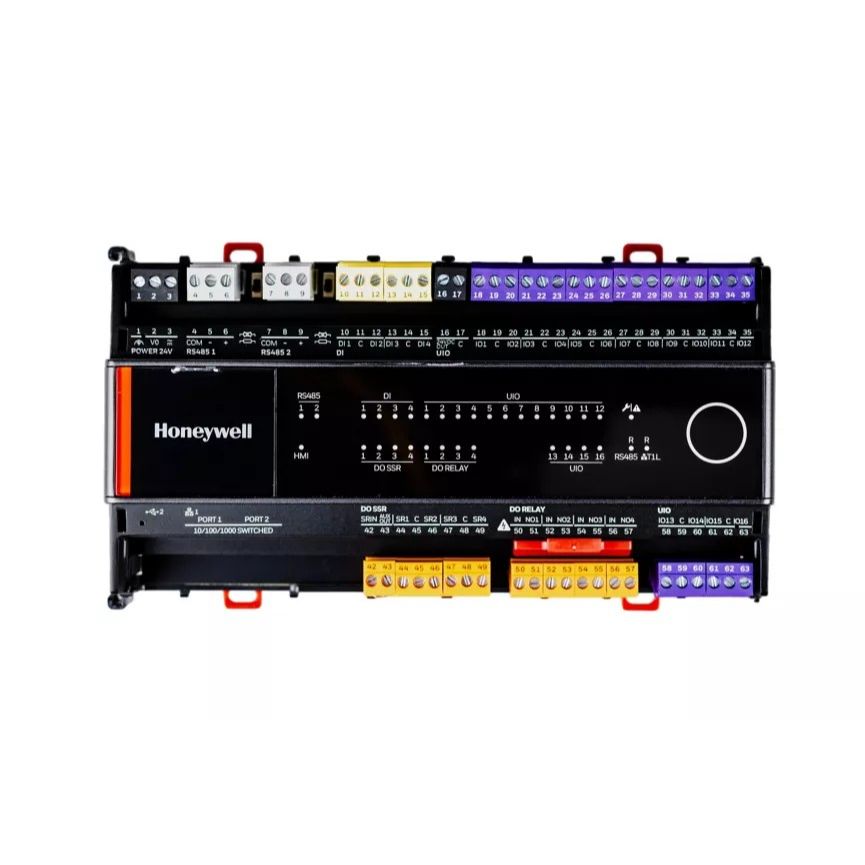
The Essential controller is a next generation small plant controller that utilizes the Niagara Framework® with optional Edge licensing, or full Niagara licensing to meet customer application needs. The Essential is a freely programmable IP device powered by a 64‑bit dual‑core i.MX processor, with 28 onboard input and output control points that provide extremely flexible control options. Using the power of the Niagara Framework®, the Essential controller provides both Ethernet & Serial integration options and is a native profile BACnet™ Building Controller (“B‑BC”).
The Essential controller has 28 onboard input and output control points (16 universal I/O channels, 4 relay outputs, 4 solid state relay outputs, and 4 digital inputs). The controller features:
- RS‑485 ports for BACnet™ MS/TP, Panel Bus (Legacy IO and SnapON IO module devices), Modbus RTU, and M‑Bus.
- Ethernet ports for BACnet™ IP devices, Modbus TCP/IP, and C‑Bus.
- RJ11 port interface for HMI devices.
- USB Type‑C interface port for serial communication.
- DIN‑rail mounting (horizontal or vertical).
FEATURES AND HIGHLIGHTS
Simple and Flexible Engineering
- Three RS‑485 non‑isolated ports and two Ethernet ports / switched IP ports.
- Ethernet ports configurable as isolated or switched.
- RJ11 port for dedicated HMI device.
- Touch flake connections for RS‑485 IO module devices.
- Switched Ethernet ports support daisy chain and RSTP.
- Built‑in RSTP switch for loop‑free network topology.
- i.MX 8M Mini dual Arm® Cortex®‑A53 processor, 1.2 GHz.
- Supports BACnet™ SC configuration within Niagara Framework®.
- Conforms to BACnet™ Standard ANSI/ASHRAE 135 protocol version 1.18.
- Supports up to 555 points (Panel Bus + Global).
Efficiency and Safety on Site
- Multi‑color LEDs for RS‑485, HMI, Ethernet, and service status.
- Two isolated IP ports for secure communication.
- Advanced diagnostics for IP and MS/TP devices.
- FRAM storage for live controller data and last‑known values.
- Protective end cover with embedded RS‑485 termination resistor.
- UTF‑8 and UCS‑2 encoding support.
- Ubuntu Core OS with snap‑based modular software design.
- Supports 802.1x authentication (Niagara N4.15u1 Rev 8+).
- Neural Net Accelerator for future low‑latency AI/ML algorithms.
Easy Upgrade
- RS‑485 ports support Panel Bus, BACnet™ MS/TP, Modbus RTU, and M‑Bus.
- Removable screw or push‑in terminal blocks.
- Built‑in HTML5 web server for graphics.
Retrofit Applications
- Form‑fit migration from CIPer™ 50 and EAGLEHAWK NX.
- Functional retrofit migration for CIPer™ 30 non‑VAV applications.
Specifications
Product Specification
Hardware
| Parameter | Specification |
|---|---|
| Ferroelectric RAM (FRAM) | 512 KB |
| LPDDR4 | 2 GB |
| EMMC | 8 GB |
| CPU | i.MX 8M Mini, dual Arm® Cortex®‑A53, 1.2 GHz |
| Operating System | Linux 64‑bit |
| Real‑Time Clock Accuracy | ±3 ppm (±1.57 min/year) |
| Real‑Time Clock Retention | 72 hours (gold capacitor) |
Electrical
| Parameter | Specification |
|---|---|
| Operating Voltage (AC) | 24 VAC ±20% (19–29 VAC) |
| Operating Voltage (DC) | 24 VDC ±20% (20–30 VDC) |
| Overvoltage Protection | Max 29 VAC or 40 VDC; terminals short‑circuit protected |
Power Consumption
| Controller | UIO (24 VAC) | UIO (24 VDC) | DI (24 VAC) | DI (24 VDC) | RO (24 VAC) | RO (24 VDC) | SSRO (24 VAC) | SSRO (24 VDC) |
|---|---|---|---|---|---|---|---|---|
| N‑EPC28‑H‑S | 76.5 VA | 33.5 W | 63 VA | 27.5 W | 62.5 VA | 27.5 W | 62.5 VA | 27.5 W |
| N‑EPC28‑H‑P | 76.5 VA | 33.5 W | 63 VA | 27.5 W | 62.5 VA | 27.5 W | 62.5 VA | 27.5 W |
Notes:
- Total power with all IO in use: 80 VA / 35 W
- Total power with no IO connected: 62 VA / 27.5 W
- If total demand exceeds 100 VA (Class 2 limit), use external power and disconnect SR input from auxiliary output.
Current Consumption
| Controller | UIO (24 VAC) | UIO (24 VDC) | DI (24 VAC) | DI (24 VDC) | RO (24 VAC) | RO (24 VDC) | SSRO (24 VAC) | SSRO (24 VDC) |
|---|---|---|---|---|---|---|---|---|
| N‑EPC28‑H‑S | 3.2 A | 1.4 A | 2.6 A | 1.15 A | 2.6 A | 1.15 A | 2.6 A | 1.15 A |
| N‑EPC28‑H‑P | 3.2 A | 1.4 A | 2.6 A | 1.15 A | 2.6 A | 1.15 A | 2.6 A | 1.15 A |
Notes:
- Total current with all IO: 1.5 A (DC) / 3.4 A (AC)
- Total current with no IO: 1.2 A (DC) / 2.7 A (AC)
- Auxiliary supply max: 6 A
- If demand exceeds 100 VA, external supply required (disconnect SR input).
Product Specification
Connection to Buses
| Protocols | Max Devices per Channel | RS‑485‑1 | RS‑485‑2 | RS‑485‑R (Wiring Adapter) |
|---|---|---|---|---|
| Panel Bus | 64 | Yes | Yes | Yes |
| BACnet™ MS/TP | 64 | Yes | Yes | Yes |
| Modbus RTU | 32 | Yes | Yes | Yes |
| M‑Bus* | 60 | Yes | Yes | Yes |
Standards and Certifications
| Parameter | Specification |
|---|---|
| Protection Class | IP20 |
| Product Standards | UL60730‑1, UL60730‑2‑9, UL916, IEC/EN60730‑1, IEC/EN60730‑2‑9, CAN/CSA‑E60730‑1:02, IEC/EN61326‑1, IEC/EN61010 |
| Testing Electrical Components | IEC68 |
| Certification | UL60730‑1, UL916, CE, BTL B‑BC, BACnet™ Standard 135 v1.14, ISO 16484‑5, AMEV AS‑B, FCC Part 15, WEEE, C‑tick RCM, CAN ICES‑3(B)/NMB‑3(B), RCM, EAC, RoHS II, IEEE 802.3 Ethernet, EN‑1434‑3, EN‑13757‑3 |
| Energy Performance | EN12098‑1:2022, EN ISO 52120‑1:2022 |
| System Transformer | Safety isolating transformers per IEC 61558‑2‑6. NEC Class 2 transformers required in USA/Canada. |
Operational Environment
| Parameter | Specification |
|---|---|
| Storage Temperature | ‑20 to 158 °F (‑28.9 to +70 °C) |
| Operating Temperature | ‑13 to 140 °F (‑25 to 60 °C) |
| Humidity | 5–95% RH (non‑condensing) |
| Vibration | 0.024″ (2–30 Hz), 0.6 g (30–300 Hz) |
| Dust/Vibration Standard | EN60730‑1 |
| Protection | IP20 with optional terminal covers |
| Pollution Level | 2 |
| Altitude | 13,123 ft (4000 m) |
Notes
- Communication rate depends on protocol.
- Panel Bus supports up to 64 IO modules per channel, max 16 of each type.
- Max Panel Bus points: 355
- Max global points: 300
- Max total points: 555
- Performance depends on poll rate, wiresheets, PX pages, histories, alarms, and drivers.
- The controller can act as an M‑Bus Master using a standard‑level converter (e.g., PW60).
- A wiring adapter is required for RS‑485‑R communication and power.